



Pedal plate
Black steel pedal deck side plate for Sim Rig – adjustable, 5 mm
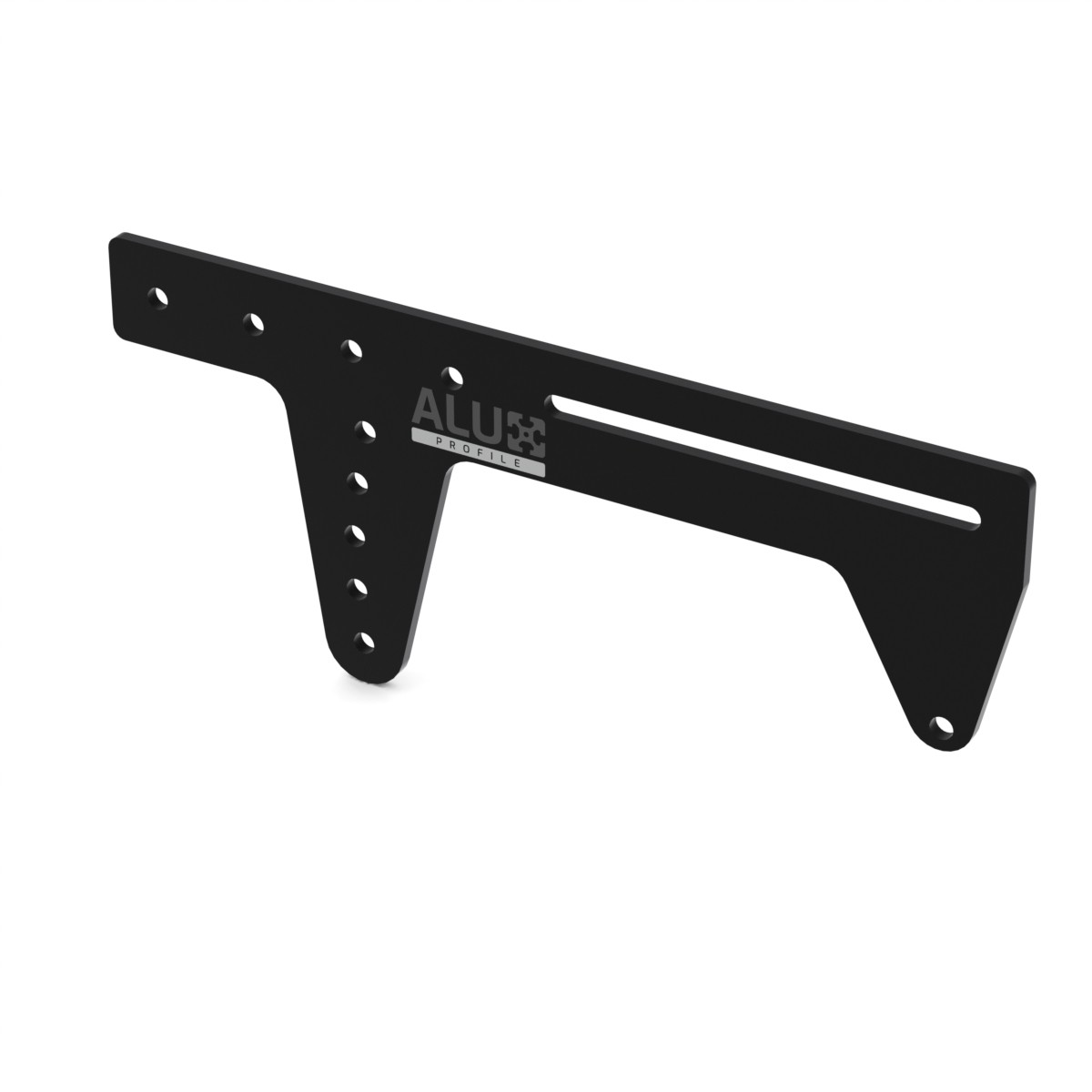
The Sim Rig pedal deck side plate is a steel side component designed for building a rigid and adjustable pedal mounting system in a racing cockpit made from structural aluminium profiles. The plate connects the profiles that form the pedal deck surface and simultaneously allows the complete module to be secured to the side profiles of the cockpit.
In the standard configuration, the plate works with Series 40 aluminium profiles: 40160-BLACK and 4080-BLACK. The 40160 profile provides a wide surface for mounting the pedals, while the 4080 profile completes the structure and increases the possibilities for adjusting the spacing of the mounting components.
The product functions as a structural side plate for the pedal deck. The pedals are not mounted directly to the plate itself, but to the slots of the 40160 and 4080 profiles connected between two side plates. To build a complete module, the use of two plates is recommended – one on each side of the pedal deck.
The plate is made from 5 mm thick steel. The steel construction helps reduce deflection of the mounting system during intensive braking and provides stable support for the profiles forming the pedal deck. The product is particularly suitable for cockpits equipped with pedals featuring stiffer springs, elastomers or a load-cell pressure sensor.
The surface of the plate is powder-coated black. The finish complements black anodised profiles, black mounting screws and the other components of a Sim Racing cockpit. The plate can also be used with profiles anodised in the natural silver aluminium colour.
Side plate for an adjustable pedal deck
The pedal deck side plate allows two cross profiles to be connected into one stable module. The arrangement of the holes and the elongated adjustment slot make it possible to adjust the position of the individual components before the screws are finally tightened.
The hole pattern can be used for:
- connecting the plate to the 40160 profile,
- connecting the plate to the 4080 profile,
- setting the relative position of both profiles,
- adjusting the angle of the pedal deck,
- adjusting the height of the module relative to the cockpit structure,
- securing the complete pedal deck to the side profiles of the Sim Rig.
The elongated slot allows smooth adjustment of the position of one of the mounting points. The remaining holes make it possible to select the appropriate structural configuration and maintain a stable position after all components have been tightened.
Adjustment of pedal angle, height and distance
After installing two plates and the 40160 and 4080 profiles, an adjustable pedal deck is created. The complete module can be configured according to the user’s height, seat position, leg length and preferred driving position.
The plates help to adjust:
- the angle of the pedal mounting surface,
- the height of the front and rear sections of the pedal deck,
- the distance between the pedals and the seat,
- the position of the complete module along the cockpit structure,
- a position suitable for GT, rally or endurance driving.
Before the screws are finally tightened, both side plates should be positioned identically. Uneven positioning of the left and right sides may cause the pedal deck to twist or the profiles to sit incorrectly.
Plate dimensions and hole pattern
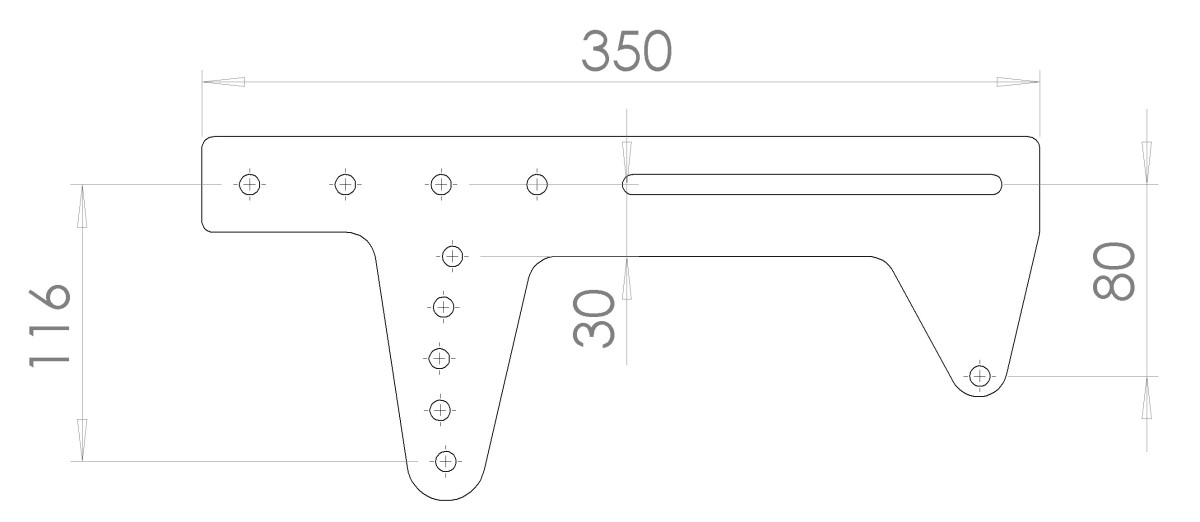
The plate has a length of 350 mm and is made from 5 mm thick sheet steel. Its shape is designed for an adjustable pedal deck in which two cross profiles are mounted between the left and right plates.
The product features:
- a pattern of round mounting holes for connection to the profiles and the cockpit structure,
- a vertical pattern of adjustment holes allowing the position of one of the profiles to be selected,
- an elongated mounting slot allowing smooth adjustment before the screw is tightened,
- a lower mounting point that stabilises the position of the plate relative to the side profile of the cockpit.
The hole arrangement allows a module with different mounting angles to be prepared without drilling additional holes in the plate itself.
Use with Series 40 profiles 40160 and 4080
The standard ALUX pedal deck uses two Series 40 aluminium cross profiles:
- 40160-BLACK aluminium profile – a wide profile forming the main mounting surface,
- 4080-BLACK aluminium profile – a profile that completes the pedal deck and increases the possibilities for positioning the pedals.
To secure two plates on both sides, the profiles should be prepared accordingly:
- 40160 profile: a total of 8× M8 threads, with 4 threads at each end,
- 4080 profile: a total of 4× M8 threads, with 2 threads at each end.
When building a pedal deck with one plate on each side, this means using six M8 screws to connect each plate to the ends of both profiles.
The total width of the completed module depends on the length of the profiles used. The same plate can be used to build a pedal deck with a width of 500 mm, 600 mm or a dimension adapted to a custom Sim Rig structure.
Recommended components for connecting one plate to the profiles
In the standard configuration with correctly tapped 40160 and 4080 profiles, we recommend using the following to secure one plate:
The black finish of the screws matches the surface of the plate and the remaining components of a black Sim Racing cockpit.
Mounting one plate to the side profile of the cockpit
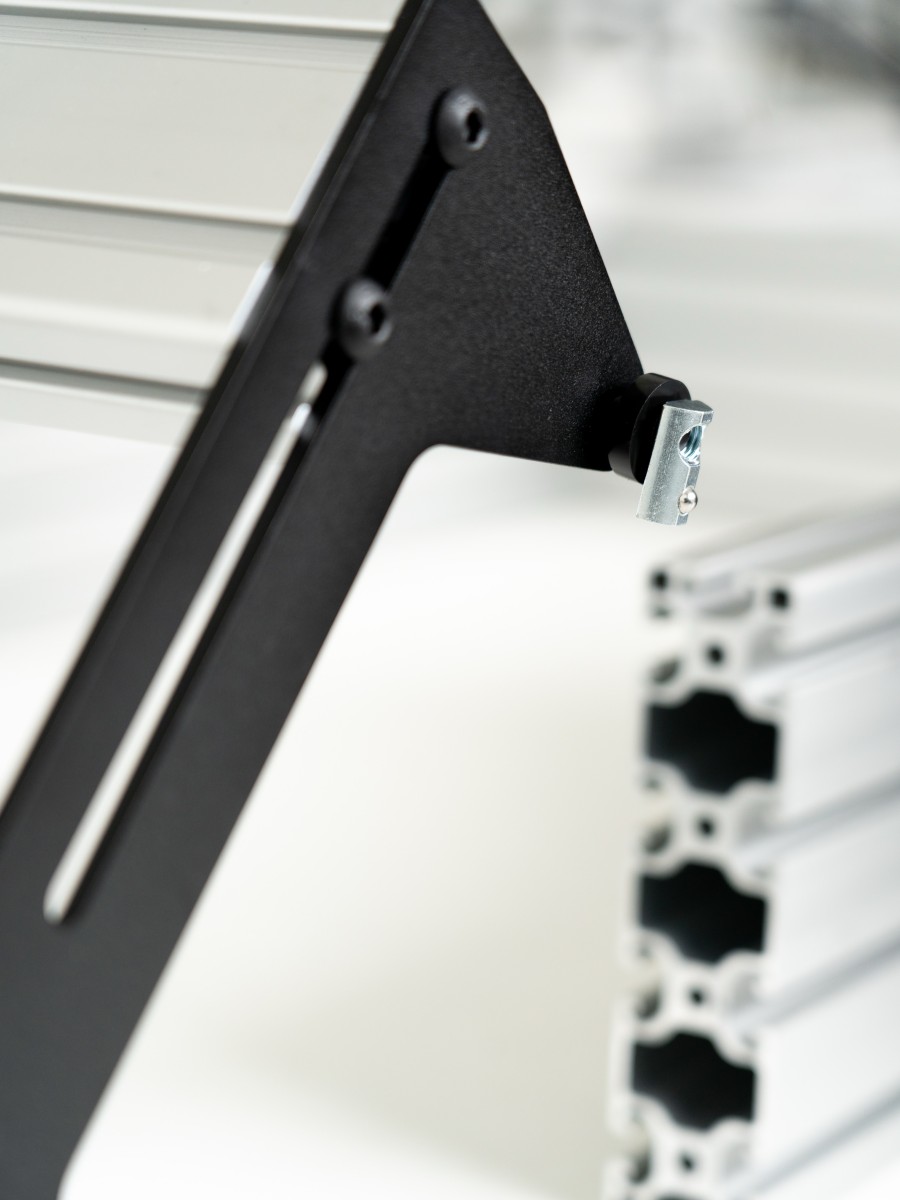
To secure one plate to a Series 40 structural aluminium profile, the following components are recommended:
- 8× ISO 7380-M8x20 BLACK
- 2× 8-4-M8.40
- 2× M8-20-5 – 5 mm thick spacer
The 8-4-M8.40 T-slot nuts should be placed in the appropriate slots of the side profile of the cockpit. The M8-20-5 spacers are positioned between the plate and the Sim Rig structure, providing the required offset and space for correct adjustment of the module.
One screw works with the elongated adjustment slot, while the other stabilises the plate at the lower mounting point. Before fully tightening the screws, the angle and position of the complete pedal deck can be changed.
Example mounting set for two plates
To build a complete pedal deck in the standard configuration, the following components are required:
- 2× 5 mm pedal deck side plate
- 1× 40160-BLACK – length adapted to the cockpit width + 8× M8 tapping
- 1× 4080-BLACK – length adapted to the cockpit width + 4× M8 tapping
- 16× ISO 7380-M8x20 BLACK
- 4× 8-4-M8.40
- 4× M8-20-5
Twelve screws are used to connect both plates to the 40160 and 4080 profiles. The remaining four screws, four T-slot nuts and four spacers are used to secure the complete module to the cockpit structure.
The components required to mount a specific pedal model in the profile slots should be selected separately according to its hole spacing and installation method.
Pedal deck side plate installation instructions
-
Prepare two plates: use one plate on the left and one plate on the right side of the module to build a complete pedal deck.
-
Select the profile length: determine the required total width of the pedal deck and prepare 40160 and 4080 profiles of the appropriate length.
-
Prepare the threads: create 8 M8 threads in the 40160 profile and 4 M8 threads in the 4080 profile.
-
Connect the first plate to the profiles: align the plate holes with the tapped profile holes and use 6 ISO 7380-M8x20 BLACK screws.
-
Install the second plate: repeat the procedure on the opposite side while checking that both plates remain parallel.
-
Place the T-slot nuts in the cockpit: insert four 8-4-M8.40 T-slot nuts into the side profiles of the Sim Rig structure.
-
Position the spacers: place the M8-20-5 spacers between the plates and the side profiles of the cockpit.
-
Secure the module initially: pass the remaining screws through the elongated and lower holes in the plates and then screw them into the T-slot nuts.
-
Adjust the position: set the height, angle and distance of the pedal deck relative to the seat.
-
Check symmetry: make sure that the left and right plates are positioned identically.
-
Tighten the mounting: tighten the screws gradually and alternately on both sides of the structure.
-
Install the pedals: secure the pedal set to the profile slots using components suitable for the specific model.
-
Perform a load test: check that the pedal deck does not change position when the brake pedal is pressed.
After the first sessions, it is advisable to check the tightness of all screws again. In structures equipped with load-cell pedals, stable mounting of both plates and the side profiles of the cockpit is particularly important.
Key features of the pedal deck side plate
- Type: structural side plate for a pedal deck
- Purpose: construction of an adjustable pedal module for a Sim Rig
- Material: steel
- Thickness: 5 mm
- Colour: black
- Finish: powder coating
- Length: 350 mm
- Mounting pattern: round holes and an elongated adjustment slot
- Thread of the recommended mounting components: M8
- Recommended profiles: 40160 and 4080
- Profile series: Series 40
- Profile slot width: 8 mm
- Recommended number of plates: 2 pieces per pedal deck
- Adjustment: pedal deck angle, height and position
- Mounting to the cockpit: M8 screws, 8-4-M8.40 T-slot nuts and M8-20-5 spacers
- Disassembly: the module can be dismantled, adjusted and reinstalled
- Application: home and professional Sim Racing cockpits
- Benefits: rigid support, wide adjustment range and modular construction
Applications of the steel pedal side plate
The pedal deck side plate can be used when building a new cockpit or upgrading an existing Sim Racing setup.
Typical applications include:
- adjustable pedal decks for Sim Racing cockpits,
- 500 and 600 mm wide pedal decks,
- pedal decks manufactured to a custom dimension,
- cockpits for GT, rally and endurance driving,
- setups with pedals equipped with a load cell,
- upgrading a standard pedal mounting system,
- custom structures made from Series 40 aluminium profiles,
- home and professional training setups.
Benefits of the Sim Rig pedal deck side plate
- allows a rigid pedal deck to be built from aluminium profiles,
- is made from 5 mm thick steel,
- features a black powder-coated finish,
- works with Series 40 profiles 40160 and 4080,
- allows the pedal deck angle to be adjusted,
- allows the height and distance of the pedals from the seat to be adjusted,
- features an elongated slot for smooth adjustment,
- allows pedal decks of different widths to be built,
- can be used with black and silver aluminium profiles,
- helps reduce deflection during intensive braking,
- is suitable for pedals equipped with a load-cell sensor,
- allows the position to be changed or the structure to be expanded later,
- can be dismantled and reused,
- provides a technical and aesthetic cockpit finish.
The product page does not specify the maximum permissible load of a single plate or the complete pedal deck. The strength of the completed module also depends on the length and cross-section of the profiles, the method of connection to the cockpit, the number of mounting points and the correct tightening of all screws.
The black steel pedal deck side plate for a Sim Rig is a functional component for building a rigid, adjustable and visually consistent pedal mounting system. The 5 mm thick steel, compatibility with the 40160 and 4080 profiles and the extensive hole pattern allow the angle, height and position of the pedal deck to be adapted to the cockpit structure and the driver’s position.
Specificaties
Related Products

Hexagon Socket Button Head Screw ISO 7380 M8x20 black

Spacer bushing M8 – 20 x 8.3 x 5 mm

Roll-in T-slot nut, 40-series M8
How do we verify our reviews?
All reviews come from customers who have actually placed an order with us. Every review is verified before it is posted online. We cannot edit reviews; we can only approve or reject them.